
It is said that the traditional Okinawan martial arts called Te and Chinese Kenpo were blended together and developed into karate. Karate later underwent significant developments in Okinawa based on several factors, including the policy of banning weapons following the political centralization of King Shoshin (1477-1526) and the Satsuma Clan’s invasion of Ryukyu (1609).
It later developed further through a process of systematization into ‘Modern Karate’, which actually had a lot to do with the efforts of the men known as the Chuko no so (The Revivers), including Sokon Matsumura (1828-1898) of the Shuri-te style, Kosaku Matsumora (1829-1898) of the Tomari-te style and Kanryo Higaonna (1853-1915) of the Naha-te style.
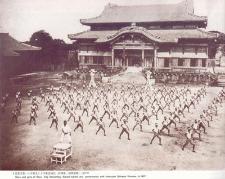
In 1908, ‘The 10 Articles of Karate’ prepared by Anko Itosu were submitted to the Educational Affairs Section of Okinawa Prefecture. After that, karate started being introduced into the school gymnastics curriculum, thus acquiring broad accessibility, in contrast to the previously secret principles of Isshi-soden (the complete transmission of a ryu’s techniques only to your heir).

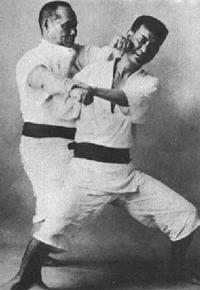
Back In the early 20th century, karate began to be introduced throughout Japan by several master, including Gichin Funakoshi (1871-1954, Founder of Shotokan-ryu), Kenwa Mabuni (1891-1952, Founder of Shito-ryu;), Kanbun Uechi (1877-1948, Founder of Uechi-ryu;) and Chojun Miyagi (1888-1953, Founder of Goju-ryu). Also throughout Okinawa, karate was taught by masters such as Chotoku Kyan (1870-1945), Choki Motobu (1870-1941) and Choshin Chibana (1885-1969, Founder of Shorin-ryu). It has been said that the original name of Todi was changed to the name ‘karate’ (empty hand) around this time.Karate began spreading around the world after the war. The biggest contributors were the many emigrants who went to live abroad full of ambition, and the U.S. military personnel occupying Japan at the time.
In 1969, karate-ka were invited from Okinawa to give a demonstration at the 1st All Japan Karate Championship Tournament held at the Nihon Budokan in Tokyo. Then in 1984, Tsuguo Sakumoto (Ryuei-ryu) won the Men’s Division of the 7th World Karate-do Championship, held in the Netherlands. In 1987, Okinawa achieved both Men’s & Women’s overall victories in the Karate-do Division of the 42nd National Sports Festival (the Autumn Session, known as Kaiho-Kokutai). Today, the young karate-ka who will be the leaders in the 21st century are boldly challenging national tournaments and world championships, and constantly topping the list of winners.
Ten Precepts Of China Hand

China Hand did not develop from Buddhism or Confucianism. In the past the Shorin School and the Shorei school were brought here from China. Both of these schools have strong points, which I will now mention before there are too many changes.
1. China Hand is not merely practiced for your own benefit: it can be used to protect one’s family or master. It is not intended to be used against a single assailant but instead as a way of avoiding a fight should one be confronted by a villain or ruffian.
2. The purpose of China Hand is to make the muscles and bones hard as rock and to use the hands and legs as spears. If children were to begin training in China Hand while in elementary school, then they will be well suited for military service. Remember the words of the Duke of Wellington after he defeated Napoleon: “Our victory here today was achieved in our school yards.”
3. China Hand cannot be quickly learned. Like a slow moving bull, it eventually travels a thousand miles. If one trains diligently everyday, then in three or four years one will come to understand China Hand. Those who train in this fashion will discover China Hand.
4. In China Hand training of the hands and feet are important, so one must be thoroughly trained on the makiwara (striking post). In order to do this, drop your shoulders, open your lungs, take hold of your strength, grip the floor with your feet and sink your energy into your lower abdomen. Practice using each arm one to two hundred times each day.
5. When one practices the stances of China Hand, be sure to keep your back straight, lower your shoulders, put strength in your legs, stand firmly and drop your energy into your lower abdomen.
6. Practice each of the techniques of China Hand repeatedly, the use of which is passed by word of mouth. Learn the explanations well and decide when and in what manner to apply them when needed. Enter, counter, release is the rule of releasing hand (torite).
7. You must decide if China Hand is for your health or to aid your duty.
8. When you train, do so as if on the battlefield. Your eyes should glare, shoulders drop, and body harden.. You should always train with intensity and spirit and in this way you will naturally be ready.
9. One must not overtrain; this will cause you to lose the energy in your lower abdomen and will be harmful to your body. Your face and eyes will turn red. Train wisely.
10. In the past masters of China Hand have enjoyed long lives. China Hand aids in developing the bones and muscles. It helps the digestion as well as the circulation. If China Hand should be introduced beginning in the elementary schools, then we will produce many men each
capable of defeating ten assailants. I further believe this can be done by having all students at the Okinawa Teachers Collage practice China Hand. In this way after graduation they can teach at the elementary schools that which they have been taught. I believe this will be a great benefit to our nation and our military. It is my hope you will seriously consider my suggestion.
Anko Itosu October 1908
BASIC CONCEPTS
The SHORIN-RYU Karate of Okinawa comes from the SHURI-TE style developed by Master Sôkon MATSUMURA. SHORIN-RYU is the pronunciation in Okinawa of the Chinese expression Shaolin which means the small forest, proof of the Chinese influence about the Tode evolution. Thus the Shaolin Quan inheritance is very present, characterised by its movement, including jumps.

The specificity of the Shorin-Ryu is the parries. That shows the superiority of the techniques over the physical strength. When we reach a good technical level, the size is not really significant. With regular training, it is possible to get efficient techniques. Master Katsuya MIYAHIRA explains that the fighting distance that we must respect is the length of a phalanx (“ishun”); it is enough to get a tremendous kime. The acquisition of such efficiency requires a deep study of the katas. In the Shorin-Ryu style, we start learning karate with the study of the NAIHANSHI katas. This kata allows to strengthen the body, and to develop the power in the short movements. The role of the breath is also crucial.
It is essential to breath naturally so that the opponent can not perceive our breath rhythm. Shorin Ruy Karate is based on the Shin gi tai principle
SHIN the Mind
GI the Method
TAI the Body
Shorin-Ryu Karate improves strength, stability and balance, precision and speed.
Some training modes on which Shorin Ryu is based are:
KIHON WAZA
Simple techniques for attacks , defence and to improve fluidity of movement
Kihon also involve the different basic stances such as “moto dachi”, “neko ashi dachi”,
“shiko dachi” and “zen kutsu dachi”.
KATA
The Shorin-Ryu katas are the originals that the first masters of karate (Master MATSUMURA,
Master ITOSU) taught. The katas have not been altered since.
BUNKAI
Kata Self Defence applications
DOJO KUMITE
Free full contact combat
KAKIE


SHAISHI
It is a training to strength building, especially for the articulations, as well as for the balance.
NIGIRI GAME
It is a training for movements , as well as kicking and balance.
TETSU GETA
It is a training to strength the legs through kicks.
MAKIWARA
It is a training to harden the fists by hitting the makiwara (thick stick for the hits). Master ITOSU used
to say: “every days, 200 Tsuki at right and left, as without makiwara, there is no Okinawa Karate”
 Matsumura Kai